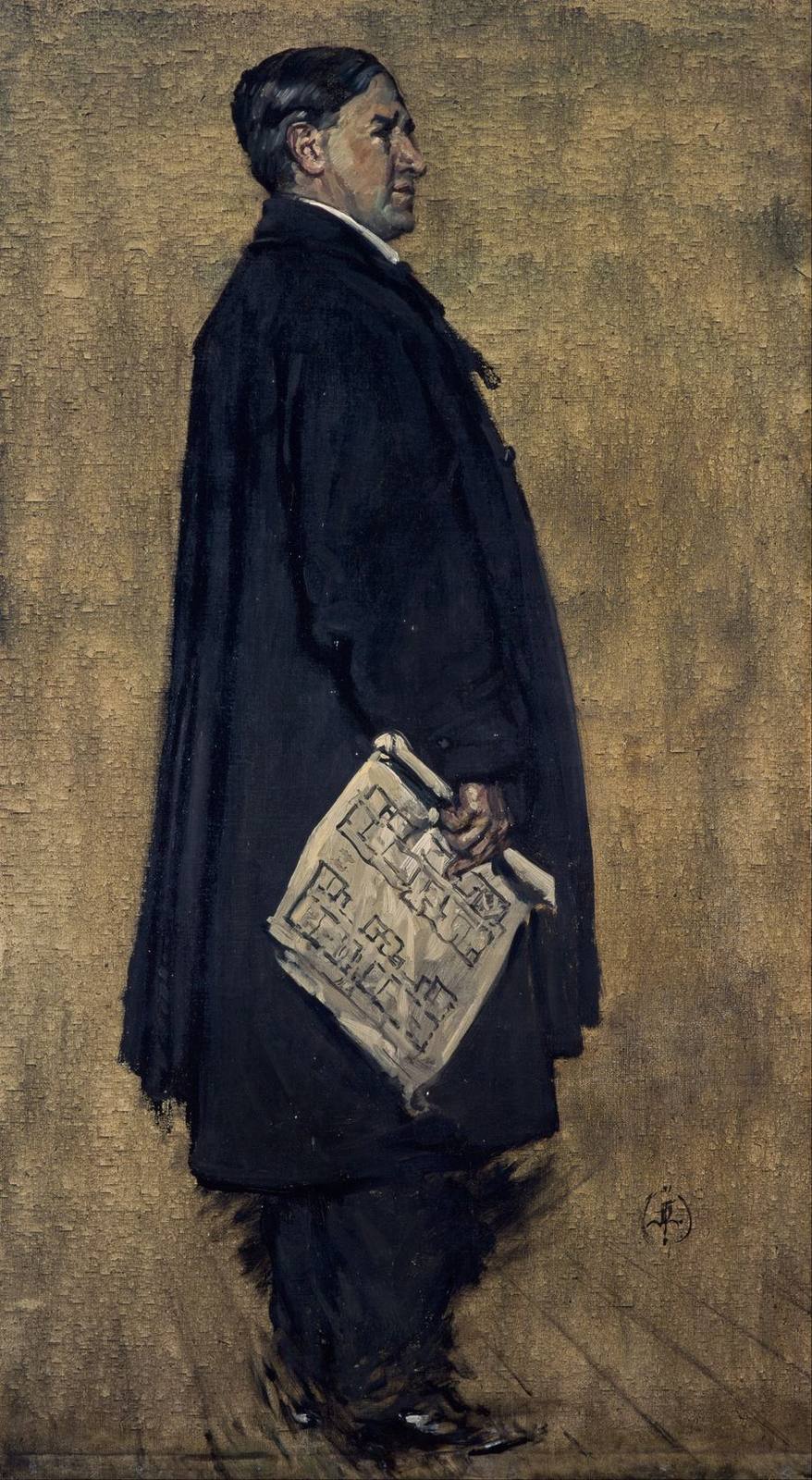
Frank Lloyd Wright: The Architect Who Made Buildings Belong
Frank Lloyd Wright, 1867 to 1959, designed more than a thousand buildings and insisted they should grow from their sites. A life of the most consequential American architect, from the Prairie houses to the Guggenheim.

Frank Lloyd Wright, 1867 to 1959, is the most famous American architect who ever lived, and the most consequential. Across a career of more than seventy years he produced over a thousand designs, of which several hundred were built, and he changed the terms on which Americans thought about houses, offices, churches, and museums. His doctrine, which he called organic architecture, held that a building should grow from its site and belong to it, as a tree belongs to its ground. Everything he built was an argument for that proposition, and the argument outlived him.
A building should grow from its site and belong to it, as a tree belongs to its ground.
He was also, by every account, a difficult man: imperious, theatrical, financially chaotic, and utterly certain of his own genius. The legend and the work are impossible to separate, and the work is better for being understood plainly, without worship. Wright's career contains masterpieces and failures, sometimes in the same building. What it never contains is indifference.
The Prairie years
Wright emerged from the Chicago of the 1890s, working first in the orbit of Louis Sullivan, the great theorist of the skyscraper, before establishing his own practice in Oak Park, Illinois. There he developed the Prairie house: long, low, horizontal compositions with open plans, bands of windows, and deep overhanging eaves that seemed to root the building in the flat Midwestern landscape. Houses like the Robie House in Chicago redefined the American domestic interior, sweeping away the Victorian warren of small rooms in favour of flowing space.
The Prairie School, as the movement around him came to be called, was the first original American architecture: not a copy of European styles but a response to the American landscape itself. Wright did not invent it alone, but he was its prophet and its greatest practitioner, and the horizontal line he drew across the prairie would become the signature gesture of his entire career.
Taliesin
In 1911 Wright built Taliesin in Spring Green, Wisconsin, part house, part studio, part declaration of independence. It would burn and be rebuilt, twice, and it would become the centre of his professional life: the place where, in 1932, he founded the Taliesin Fellowship, the apprentice community that trained generations of architects in his methods. Taliesin was more than an office. It was a way of life, organised around the master's conviction that architecture was not a profession but a calling, and that buildings should be made by people who understood the land they stood on.
The Fellowship system was controversial in its own time and remains so: a mixture of genuine education and personal fiefdom, of brilliant teaching and unpaid labour. But it produced architects, and it kept Wright's practice alive through the lean years when commissions were scarce and his reputation, in the 1920s, had badly faded.
The return
The comeback, when it came, was spectacular. In the mid-1930s, with the Depression still biting, Wright produced the two works that restored him to the centre of American architecture: Fallingwater (1935 to 1938), the weekend house over Bear Run in Pennsylvania that became the most famous private house in the world, and the Johnson Wax headquarters in Racine, Wisconsin, with its forest of dendriform concrete columns. Both are mature statements of organic architecture: buildings whose forms seem to grow from their purposes and their sites rather than being imposed upon them.

Wright's method in these years was famously improvisational. He designed Fallingwater, legend holds, in the hours before Kaufmann arrived to review the drawings, having carried the composition in his head for months. Whether or not the story is literally true, it captures something real about how he worked: long gestation, sudden execution, and total confidence in the synthesis of site and structure.
The late 1930s also brought the Usonian houses, Wright's attempt to design beautiful, affordable homes for the American middle class: modest, flat-roofed, radiant-heated, and radically open in plan. Few were as cheap as he promised, but the ideas filtered into the American suburb and never left: the carport, the open kitchen, the blurring of indoors and out.
The Guggenheim and the last act
Wright's final decade was astonishingly productive. The Solomon R. Guggenheim Museum in New York, commissioned in the 1940s and completed in 1959, the year of his death, is his most famous public building: a great spiralling ramp of concrete that turned the museum visit into a continuous promenade. Critics argued about whether the architecture overwhelmed the art. Visitors have never stopped coming.
He died in 1959 at ninety-one, still working, still certain. In 2019, eight of his works, spanning the Prairie houses to the Guggenheim, were inscribed on the UNESCO World Heritage List as The 20th-Century Architecture of Frank Lloyd Wright, recognised for their mature expression of organic architecture. It was the first modern American architecture to receive the honour.
The man and the myth, plainly
Wright's influence is so total that it is hard to see. The open plan, the carport, the house fused with its landscape, the architect as public personality: all of these are, in large part, his inventions or his popularisations. But the honest account must include the failures. His buildings leaked. His structures sometimes deflected, famously at Fallingwater. His clients endured cost overruns and imperious treatment. He was, by many accounts, impossible.
None of that diminishes the achievement. It clarifies it. Wright's greatness was not in being right about everything but in being original about the things that mattered: the relationship of a building to its ground, the flow of space, the American house as an idea. A thousand designs, several hundred buildings, and a doctrine that still shapes how architects think about site. No American architect has mattered more.
Sources
Factual claims in this article are traced to the sources above, per our editorial standards.